

What to Look for in an ARBD Care Home: A Family’s Guide to Choosing the Right Support
Once a diagnosis of alcohol-related brain damage has been given, many families reach a second, equally difficult question: what kind of care home actually gets this right? ARBD, along with its related conditions, Wernicke's encephalopathy and Korsakoff's syndrome, needs a different kind of expertise than standard dementia or residential care. Knowing what to look for makes the search considerably less overwhelming.
Why Does ARBD Need a Different Kind of Care Home?
ARBD isn't simply an alcohol-related version of dementia. Research from the Royal College of Psychiatrists describes it as a spectrum condition, caused by long-term heavy alcohol use combined with thiamine deficiency, and notes that general dementia services don't always have the specific skills ARBD requires.
One feature sets ARBD meaningfully apart from most dementias. Research reviewed in a 2023 study on ARBD services found that, unlike progressive dementia, ARBD is not necessarily degenerative. With abstinence, good nutrition and the right rehabilitation, some people see genuine functional improvement, particularly when support starts early. A care home built around general dementia care, rather than ARBD specifically, may not be set up to support this kind of recovery at all.
This is why the search for the right home needs to go beyond "does it support dementia" and ask specifically whether it understands alcohol-related brain damage, Wernicke's encephalopathy and Korsakoff's syndrome as their own distinct conditions.
Does the Home Have Genuine ARBD-Specific Experience?
It's worth asking directly how many residents the home currently supports with ARBD, rather than dementia more broadly, and how staff are trained to recognise its particular features. Confabulation, where someone fills memory gaps with sincerely believed but inaccurate details, is a hallmark of Korsakoff's syndrome specifically, and staff need to understand this as a feature of the condition, not dishonesty.
A history of Wernicke's encephalopathy is another detail worth raising early. It's an acute neurological emergency caused by severe thiamine deficiency, and anyone who has experienced it needs ongoing monitoring, since it can recur and may progress into Korsakoff's syndrome without careful management.
Vane Hill Care Home in Torquay is built specifically around these three conditions, Alcohol-Related Brain Damage, Wernicke's Encephalopathy and Korsakoff's Syndrome, rather than treating ARBD as a sub-category of general dementia support.


Is the Approach Built Around Rehabilitation, Not Just Supervision?
One of the clearest signs of a genuinely specialist ARBD home is whether care is framed around rebuilding skills, not simply keeping someone safe day-to-day. Because ARBD can improve with the right support, a home that only offers supervision may be missing a real opportunity for a resident to regain independence.
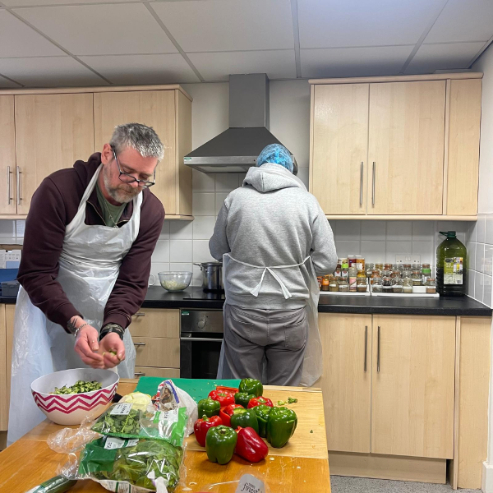
Ask how the home structures rehabilitation in practice. Is there a defined programme, with personal goals and a dedicated point of contact, or is support more generic? At Vane Hill, this takes the shape of a 3 Step Enablement Programme, where each resident works with a dedicated Key Worker on a personal goal over a six-month period, using everyday tasks like meal preparation to rebuild functional skills gradually.
It's worth being clear that this kind of support manages and rehabilitates; it does not reverse existing brain damage, and any acute medical episode still needs urgent hospital treatment. A good home should be upfront about this distinction, not vague about what rehabilitation can realistically achieve.
What Does the Multidisciplinary Team Actually Look Like?
ARBD rarely presents as a single, isolated problem. Research on ARBD presentations in acute hospitals notes that up to a quarter of cases involve additional traumatic brain injury or vascular changes, meaning a resident may be managing several overlapping difficulties at once.
This is why the team behind a home matters as much as the building itself. Ask specifically who is involved day-to-day: registered nurses, occupational therapists, speech and language therapists, and mental health specialists, rather than accepting a general answer about "trained staff." A genuinely multidisciplinary team means a change noticed by one professional- reduced appetite, altered mobility- can prompt a quick, coordinated response rather than being missed until it becomes a bigger problem.
How Is Nutrition Managed Within the Home?
Nutrition deserves more attention in this search than families often expect. Thiamine deficiency sits at the root of how Wernicke's and Korsakoff's develop, so ongoing attention to diet and hydration isn't a lifestyle nicety, it's a genuinely clinical part of ongoing care.
Ask how the home approaches dining for residents with ARBD specifically, and whether nutritional needs are built into individual care plans rather than handled as a separate, generic catering function. Tailored dining that reflects individual nutritional needs supports both physical recovery and cognitive stability over time.

What Does Daily Life Actually Look Like for Residents?
Beyond the clinical picture, it's worth understanding what a typical day involves. Predictable routines reduce the cognitive load of working out what happens next, which matters considerably for someone with memory impairment. Ask how structured the day is, and how much flexibility exists for individual preferences within that structure.
The physical environment plays a role too. Calm, well-organised communal spaces, such as lounges, a games room and gardens, support both social connection and purposeful activity, while quieter private spaces give residents room to settle when they need to.
How Should You Check the Home's Track Record?
Every registered care home in England is inspected by the Care Quality Commission, which rates services against five key questions: whether they are safe, effective, caring, responsive and well-led. Reading the full inspection report, not just the headline rating, gives a much clearer picture of how a home actually operates day-to-day.
It's also worth looking at independent review platforms, which reflect direct feedback from residents and families rather than a single inspection snapshot. Taken together with a visit and a direct conversation with staff, this gives a far more rounded view than any single source alone.
Bringing the Decision Together
Choosing an ARBD care home comes down to a handful of genuinely answerable questions: does the home understand ARBD specifically, rather than treating it as general dementia care; is rehabilitation genuinely built into daily life, not just supervision; and is there a multidisciplinary team in place that can respond quickly when something changes? Visiting in person and asking these questions directly tends to reveal far more than a website ever can.
If you're exploring ARBD, Wernicke's encephalopathy, or Korsakoff's syndrome care in or around Torquay, the team at Vane Hill Care Home is happy to talk through what support might look like for someone you love, and to arrange a visit so you can see the home and meet the team for yourself.

Frequently Asked Questions
What's the difference between ARBD care and general dementia care?
ARBD care is built around the specific features of alcohol-related brain damage, including confabulation and the genuine possibility of functional improvement, whereas general dementia care is typically designed around progressive, irreversible decline.
Can someone with ARBD actually improve in a care home?
Some people do see real improvement, particularly with early intervention, good nutrition and structured rehabilitation, though outcomes vary significantly between individuals.
What questions should I ask when visiting a potential ARBD care home?
Ask about staff experience specifically with ARBD, how rehabilitation is structured, who makes up the multidisciplinary team, and how nutrition is managed as part of individual care plans.
Does a diagnosis of Wernicke's encephalopathy affect ongoing care needs?
Yes. Anyone who has experienced Wernicke's encephalopathy needs ongoing monitoring, since the condition can recur and may progress into Korsakoff's syndrome without careful management.
How can I check a care home's quality before choosing it?
Read its full CQC inspection report, not just the overall rating, and look at independent review platforms alongside a personal visit to the home.
If you'd like to talk through what ARBD care might look like for someone you love, the team at Vane Hill Care Home in Torquay is happy to answer questions or arrange a visit.